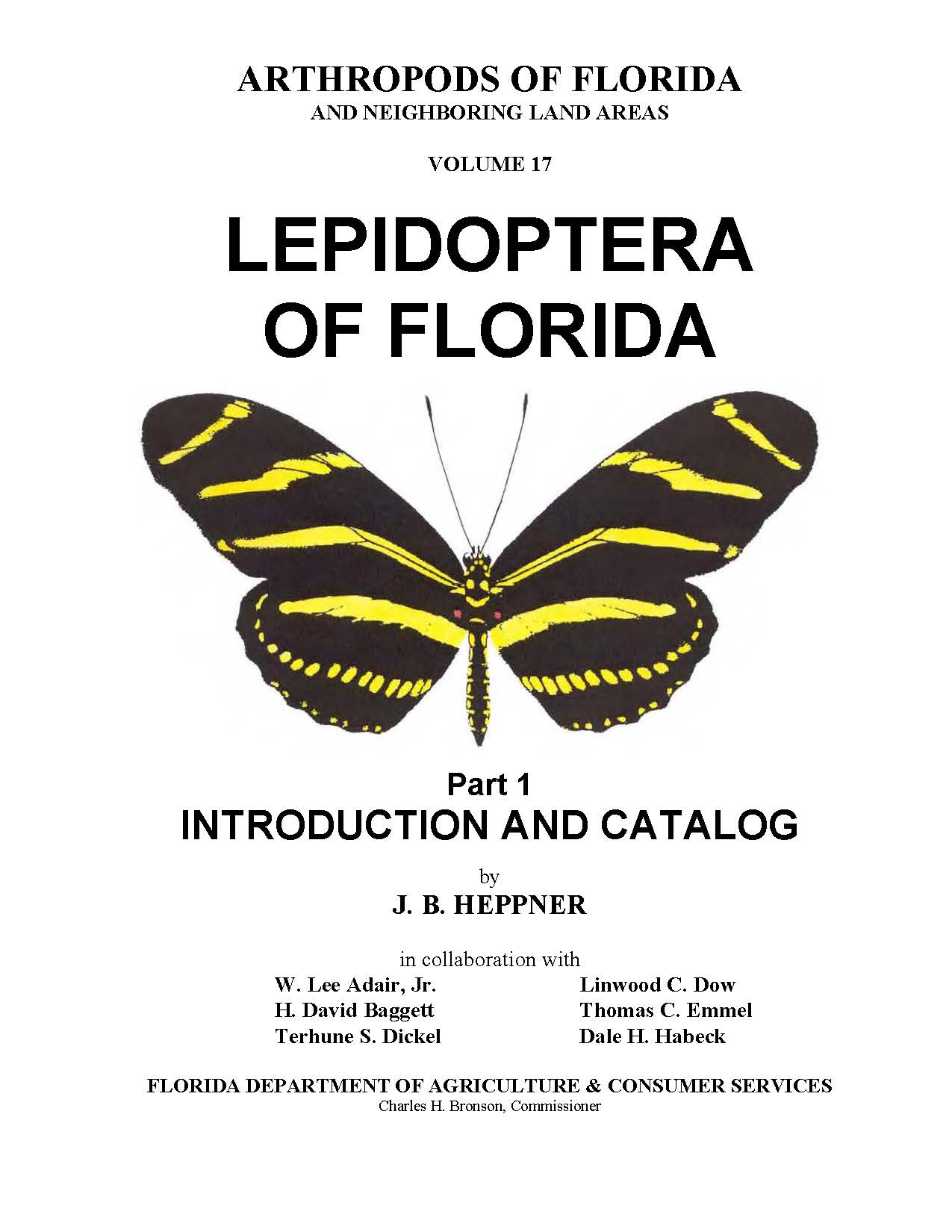
Lepidoptera of Florida. Part 1. Introduction and Catalog
Arthropods of Florida and Neighboring Land Areas
Volume 17 | 2003 (original) | 2007 (revised)
John B. Heppner
Florida State Collection of Arthropods, FDACS Adjunct Professor, University of Florida Research Associate, Smithsonian Institution
How to cite
Heppner JB. 2003. Lepidoptera of Florida. Part 1. Introduction and Catalog. Arthropods of Florida and Neighboring Land Areas, Volume 17: 1–670.https://doi.org/10.64338/fsca.af.17.q8t22.
Abstract
The Lepidoptera of Florida are cataloged, totalling 2,941 species, later to be diagnosed and illustrated in the planned 10 part series. This first part includes a general introduction to the Lepidoptera, including the general morphology of Lepidoptera families and keys for their identification, and sections on Florida ecosystems and environment as this relates to the Florida Lepidoptera fauna and its biology. The main text of this first part on Florida Lepidoptera involves a catalog of all verified resident species of moths and butterflies and regular visitor species, excluding erroneous records and rare strays. The catalog is an altered revision of Kimball’s (1965) checklist, which was Volume 1 of the Arthropods of Florida and Neighboring Land Areas series. Coverage for each species includes the following: the full scientific name and synonyms thereof; any common name known for the species; notation of the current MONA checklist (Hodges, et al., 1983) and McDunnough checklist (1938-39) numbers; indication of the range within Florida, based on biogeographic regions developed for Florida vegetation by West and Arnold (1952) and also used by Kimball (1965), the known range for the species elsewhere; date ranges by month for known adult activity; and known hostplants arranged alphabetically by plant genus and species. Indices include a hostplant index arranged alphabetically for all plant genera, species, and plant names, plus indices for common and scientific names of Lepidoptera. Illustrations include numerous maps and photographs showing the physical and natural environment of Florida, and 55 plates showing more than half of the Florida Lepidoptera species. The introduction includes a review of the family classification and a world-wide key to families. Also included are lists of Florida pest species and their common names, and lists of beneficial, stray, and endemic species. Species recorded in error for Florida are also noted, as are name changes. New synonymies are in Hesperiidae (4147), Nymphalidae (4557 and 4576), and Noctuidae (11104). New combinations are in Nepticulidae (113, 115, and 118) and Elachistidae (1124.1 and 1132.2). New status changes are in Lycaenidae (4354), Nymphalidae (4576), Geometridae (6486, 6487, and 6735) and Lymantriidae (8298).